.jpg)
March Mandarin Moments: Growing Through Feelings & Everyday Life
- Mandarin Bee
- Mar 4
- 4 min read
In February, we wove Mandarin into waking up, getting dressed, and heading out the door.
In March, we dig a little deeper as we focus on something children experience every day: feelings. When children can name their emotions in Mandarin, the language becomes personal. And when it becomes personal, it lasts.
The good news is: Emotions already show up in the car, at the playground, during errands, and before bed. We don’t need new teaching time, we can simply name (in Mandarin) what’s already there.
🚗 Car Ride Curiousity
Car rides are frequent, repetitive, and can be full of big emotions.
👶 EARLY Mandarin (Age 0-5)
Keep it simple. Name the feeling gently.
开心 (kāi xīn) — happy
不开心 (bù kāi xīn) — not happy
累 (lèi) — tired
You might say:
开心吗? (kāi xīn ma?) — Happy?
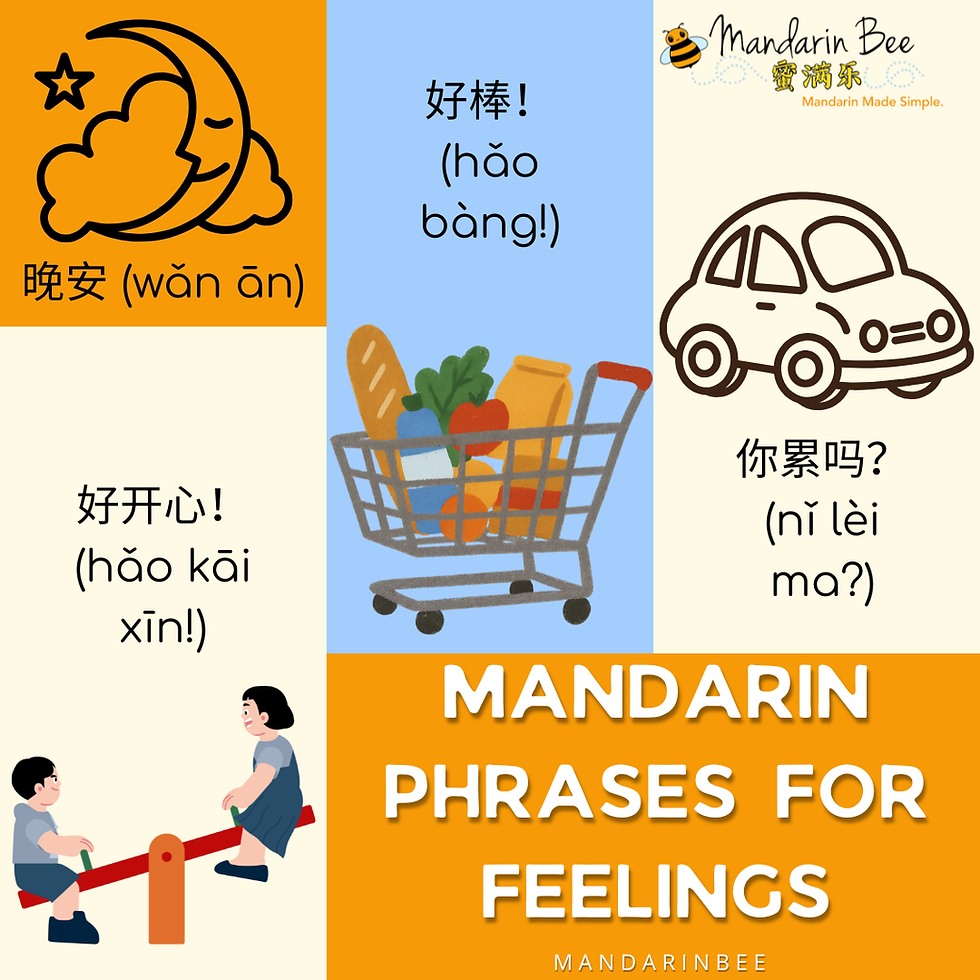
累吗? (lèi ma?) — Tired?
Even if your child only nods or responds non-verbally, they’re connecting the word to the feeling.
👦 Mandarin EXPLORER (Age 6-12)
Older children can handle fuller phrases, so you can begin to model sentences for them to listen to and absorb.
你开心吗? (nǐ kāi xīn ma?) — Are you happy?
你累吗? (nǐ lèi ma?) — Are you tired?
你为什么不开心? (nǐ wèi shén me bù kāi xīn?) — Why are you not happy?
You can model your own feelings too as examples:
妈妈有一点累 (mā ma yǒu yì diǎn lèi) — Mum is a little tired.
爸爸很开心 (bà ba hěn kāi xīn) — Dad is very happy.
When children hear emotional language used naturally, Mandarin becomes relational, not instructional.
🛝 At the Playground: Big Feelings in Big Bodies
Playgrounds are where emotions show up loudly.
👶 EARLY Mandarin (Age 0-5)
Keep it expressive and short.
好开心! (hǎo kāi xīn!) — So happy!
勇敢! (yǒng gǎn!) — Brave!
没关系 (méi guān xi) — It’s okay
难 (nán) — Difficult
When they hesitate before climbing:
勇敢! (yǒng gǎn!)
When something doesn’t work:
没关系~ (méi guān xi)
Short, repeated words stick beautifully at this age.
👦 Mandarin EXPLORER (Age 6-12)
Older children can reflect a little more on their feelings and emotions.
你很勇敢 (nǐ hěn yǒng gǎn) — You are very brave
有一点难 (yǒu yì diǎn nán) — It’s a little difficult
你有一点害怕吗? (nǐ yǒu yì diǎn hài pà ma?) — Are you a little scared?
Core emotional vocabulary to expand this month:
难过 (nán guò) — Sad
生气 (shēng qì) — Angry
害怕 (hài pà) — Scared
失望 (shī wàng) — Disappointed
兴奋 (xīng fèn) — Excited
开心 (kāi xīn) — Happy
Because older children experience more complex emotions, offering nuanced words helps them express more than just “happy” or “not happy.”
Like what you're seeing so far?
🛒 Errands: Everyday Emotional Language
Teaching moments can happen anywhere, even during grocery runs.
👶 EARLY Mandarin (Age 0-5)
Use simple, practical phrases:
等一下 (děng yí xià) — Wait a moment
谢谢 (xiè xie) — Thank you
好棒! (hǎo bàng!) — Great job!
When they help carry something:
好棒! (hǎo bàng!)
Words for encouragement are powerful at this age.
👦 Mandarin EXPLORER (Age 6-12)
Add fuller expressions:
谢谢你 (xiè xie nǐ) — Thank you
你好厉害 (nǐ hǎo lì hai) — You’re amazing
你帮了很多 (nǐ bāng le hěn duō) — You helped a lot
谢谢你收到 (xiè xiè nǐ shōu dào) — Thank you for getting the… (refer to February's blogpost for ingredient ideas!)
Language becomes tied to responsibility and pride.
🌙 Bedtime: A Reflective End to the Day
Bedtime is where emotional language softens and settles as your child winds down and reflects on the day.
👶 EARLY Mandarin (Age 0-5)
Keep it warm and simple:
开心吗? (kāi xīn ma?) —Are you happy?
难过吗? (nán guò ma?) — Are you sad?
晚安 (wǎn ān) — Good night
You can gently label:
开心 (kāi xīn) — Happy
难过 (nán guò) — Sad
累 (lèi) — Tired
At this age, tone and comfort matter more than sentence length.
👦 Mandarin EXPLORER (Age 6-12)
Invite gentle reflection as they get ready to close their eyes and drift into well-earned slumber.
你今天开心吗? (nǐ jīn tiān kāi xīn ma?) — Were you happy today?
你今天为什么生气? (nǐ jīn tiān wèi shén me shēng qì?) — Why were you angry today?
你有一点难过吗? (nǐ yǒu yì diǎn nán guò ma?) — Are you a little sad?
These questions don’t need long answers. Even short replies build emotional vocabulary.
And always close with a heartfelt 晚安 (wǎn ān) as you bid your child a good night.
📘 Want all the Mandarin Bee phrases in one place?
If your child is enjoying these games, we’ve created a free Mandarin Bee Morning Phrase Guide to support you through all four weeks. Inside, you’ll find:
The key phrases from shared in the blog post
Extra everyday vocabulary to build confidence naturally
Mandarin + pinyin + English for every phrase
Simple options for younger (0–5) and older (6–12) children
💛 Ready to start your Child’s Mandarin Journey? Register for our TRIAL Class
If you’d like Mandarin to become part of your child’s weekly routine, register for a TRIAL Class today!
The programs we offer:
EARLY Mandarin (For Age 0–5)
Mandarin EXPLORER (For Age 6–12)
📍 Mitcham & Templestowe
📲 Stay Connected With Us
For simple tips, classroom moments, and updates on programs and workshops, follow us on social media: Instagram & Facebook
We share:
Easy Mandarin phrases for home use
Behind-the-scenes learning moments
Programme updates and reminders
A Final Note for March
As we head into March, the goal is to build connections between Mandarin and emotions. For younger children, repetition builds recognition; for older children, conversation builds depth. Connection builds confidence, giving them a path to make Mandarin a language they feel comfortable conversing in.


Comments